ECG Health Kiosk
Self-Service ECG Kiosks
Powered by AI,
Built for High-Volume Screening
KIOT’s compact ECG kiosk delivers medical-grade heart health insights in under 2 minutes—without gels, wires, or operator assistance. Perfect for hospitals, corporate parks, diagnostic centers, and wellness hubs aiming to scale cardiac screening effortlessly.
📈 Medical-grade reports
🧠 AI-powered by ChatGPT
⏱️ 2-minute screening
Why It Matters?
80% of Heart Issues Go Undetected Until It’s Too Late
Many cardiac conditions are asymptomatic until they become severe—including arrhythmias, ischemia, and early-stage heart disease.
Regular ECG screening is underutilized due to the need for technicians, discomfort with traditional equipment, and limited awareness.
KIOT’s kiosk removes these barriers, allowing anyone to screen themselves in minutes—no appointment, no referral.
Limited ECG Access
Traditional ECG setups require trained staff, disposable supplies, and space, which most non-hospital settings cannot provide.
Rural clinics, small health centers, schools, gyms, and public spaces often lack access to cardiac diagnostic tools.
Our self-service kiosk makes medical-grade ECGs available anywhere, eliminating the reliance on medically trained personnel or infrastructure.
2-Minute Self-Test Enables Early Detection & Decentralized Care
With just a hand and foot contact, users get real-time insights into their heart rhythm, stress recovery, and arrhythmia risk. Whether it’s AFib, tachycardia, ischemia, or QT abnormalities, the system flags key warning signs—instantly. This empowers proactive care, reduces hospital load, and supports population-level cardiac screening programs.
What is KIOT Self-Service ECG Kiosk?
The KIOT Self-Service ECG Kiosk
is a compact, AI-enabled station that lets anyone perform an accurate ECG scan—without needing medical assistance.
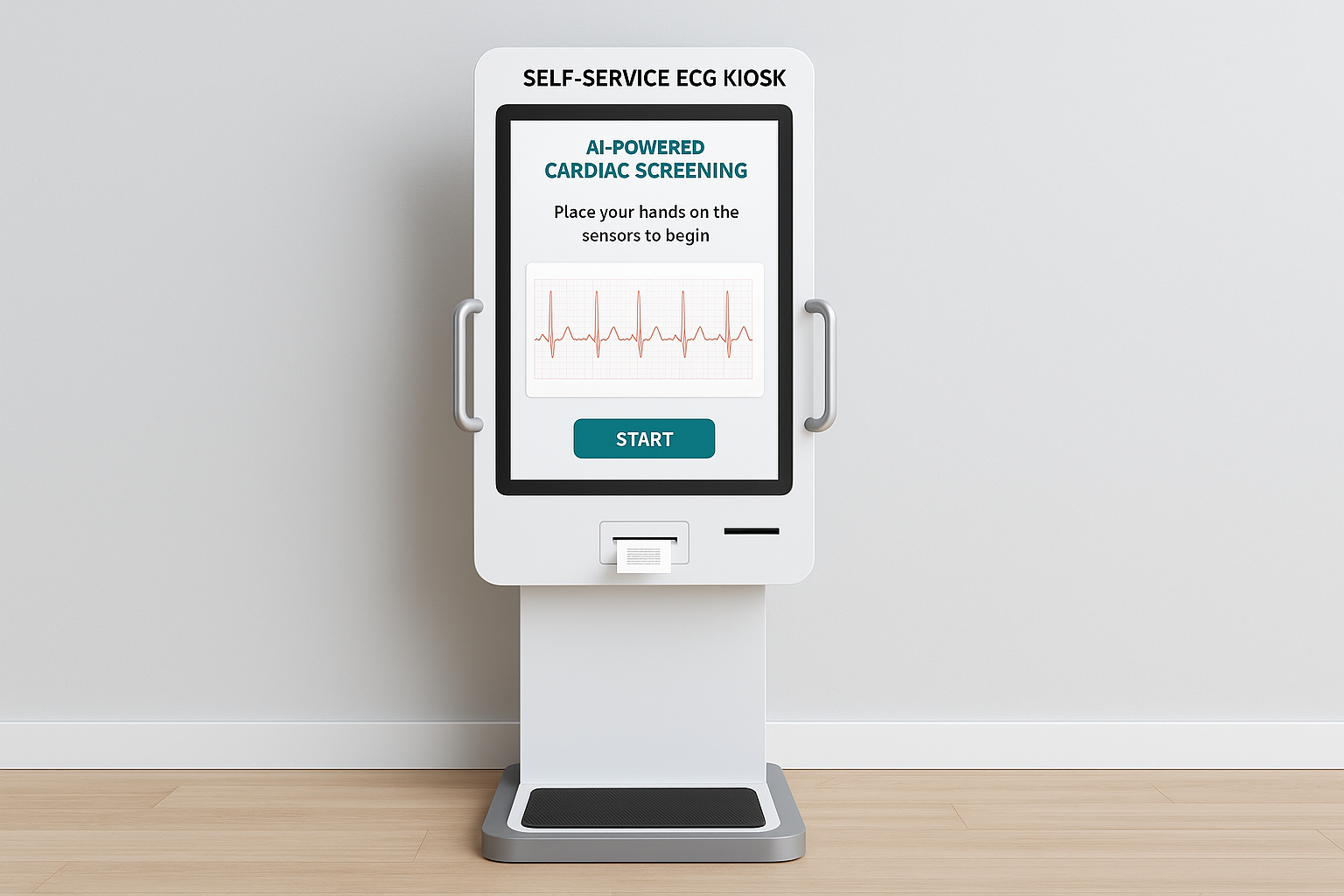
Users simply hold two metal grips and place a foot on the sensor plate. In under 2 minutes, they receive a complete AI-analyzed heart health report—printable, emailable, and readable in layman’s terms.
Key Benefits
✅ Fully Self-Service – No Technician Required
Users can independently perform a complete ECG test by simply following on-screen instructions. No trained personnel, appointments, or manual intervention are needed—making it ideal for 24/7 deployment in high-traffic locations.
📄 Instant AI-Generated Health Report
Within 2 minutes, users receive a detailed ECG interpretation, combining medical accuracy with plain-language explanations. Results can be viewed, emailed, or linked to a mobile number for follow-up.
🧠 AI-Powered Clinical Insights
Monitor and optimise patient flow in high-impact hospital areas: Emergency Triage & Bed Assignment, Inpatient Admission & Discharge, Pre-Op Holding & Post-Op Recovery, Outpatient Clinic Journey, Radiology Queue Management, and High-Risk Zone Monitoring (e.g., dementia units)
🩺 Detects Early Signs of Cardiac Events
Automatically flags arrhythmias (AFib, bradycardia, tachycardia), ischemic indicators, QT prolongation, and more—helping users catch silent cardiac conditions early.
🌐 Connected & Offline-Ready
Supports real-time cloud analysis via secure API or future-proof offline processing using embedded ML models—ideal for both metro and remote installations.
🧼 Touch-Free & Hygienic Design
The user interacts only via metal hand grips and a foot sensor—no disposable items, no wires, no physical prep. The system is designed for rapid, hygienic use in public environments.
Using the KIOT ECG Kiosk is This Simple
Step 1: Walk Up and Begin
The user approaches the kiosk and selects "Start" on the touchscreen interface. On-screen and voice guidance make the process easy—even for first-time users.
Step 2: Contactless ECG Capture
The user holds two metal grips and places one foot on the sensor plate.
Step 3: Real-Time ECG Data Collection
The kiosk captures a 6-lead ECG signal using precision sensors and onboard ECG hardware (ADS1298).
Step 4: AI-Based Interpretation
The system sends the data securely to the ChatGPT API, which generates both clinical and user-friendly interpretations.
Step 5: Report Sent to User’s Mobile Number
Once complete, the ECG report is automatically sent to the user’s registered phone number via SMS or secure link.
Step 6: Instant On-Screen & Print Option
The report appears instantly on the kiosk screen and can also be sent via email or to the user’s registered mobile number for later access.
Step 7: Ready for Any Location
The kiosk uses plug-and-play hardware with touchscreen, BLE connectivity, and optional thermal printing.
Step 8: Cloud-Connected or Offline-Ready
Connects to ChatGPT API for full AI interpretation, with optional local model support via Android or Raspberry Pi for offline deployments.
Detected Health Parameters
These metrics are relevant for general users, corporate wellness, and fitness monitoring.
Heart Rate (BPM)
Detects if the heart is beating too fast, too slow, or within a normal range—an essential marker of fitness or fatigue.
Rhythm (Sinus or Irregular)
Identifies whether the heartbeat is following a regular sinus pattern or has unexpected variations—often the first sign of arrhythmia.
Heart Rate Variability (HRV)
Evaluates stress and recovery balance by analyzing variability between heartbeats. Useful for athletes, working professionals, and preventive health programs.
These parameters highlight common cardiac issues requiring monitoring or early intervention.
Arrhythmia Detection
(AFib, Bradycardia, Tachycardia)
Flags heart rhythms that are irregular (AFib), too slow (bradycardia), or too fast (tachycardia).
Electrical Axis Deviation
Measures the heart's electrical orientation—shifts in this axis may indicate ventricular strain, past heart attacks, or anatomical abnormalities.
PR, QRS, QT Interval Analysis
Evaluates the timing of different phases of the heartbeat to detect conduction delays or repolarization issues.
AV Block or Bundle Branch Delays
Identifies blocks in electrical signal conduction, which may cause dizziness, fatigue, or risk of heart failure if unaddressed.
These indicators can signal life-threatening conditions and require immediate medical evaluation.
ST Elevation or Depression
Suggests reduced blood flow to the heart muscle—a key sign of ischemia or possible heart attack.
Prolonged QT Interval
Indicates risk of dangerous arrhythmias (like Torsades de Pointes), often caused by medication or electrolyte imbalance.
T-Wave Abnormalities
Flags inversion, flattening, or peaking of the T-wave, which may indicate ischemia, hyperkalemia, or stress.
Pericarditis or Brugada Syndrome Markers
Rare but serious syndromes detected through characteristic ST/T changes—especially in younger, high-risk populations.
Use Case & Industries
What This Means for Your Facility
Healthcare providers that deploy self-service ECG kiosks experience immediate efficiency gains—reducing dependency on technicians, minimizing queue times, and enabling 24/7 cardiac screening without added operational burden.
Traditional ECG setups require trained staff, scheduled appointments, and costly consumables. In contrast, KIOT’s kiosk eliminates these recurring costs while expanding access to diagnostics across your facility—be it a hospital lobby, clinic, or wellness zone.
Each kiosk can screen hundreds of users per month at a cost of just cents per report. And with automated AI interpretation, clinical-grade insights are delivered instantly—supporting triage, preventive care, and remote monitoring initiatives.
In short: it’s a one-time investment that delivers scalable screening, reduces workload, and strengthens your preventive health infrastructure—paying for itself in weeks, and delivering lasting impact.